
No products in the cart.
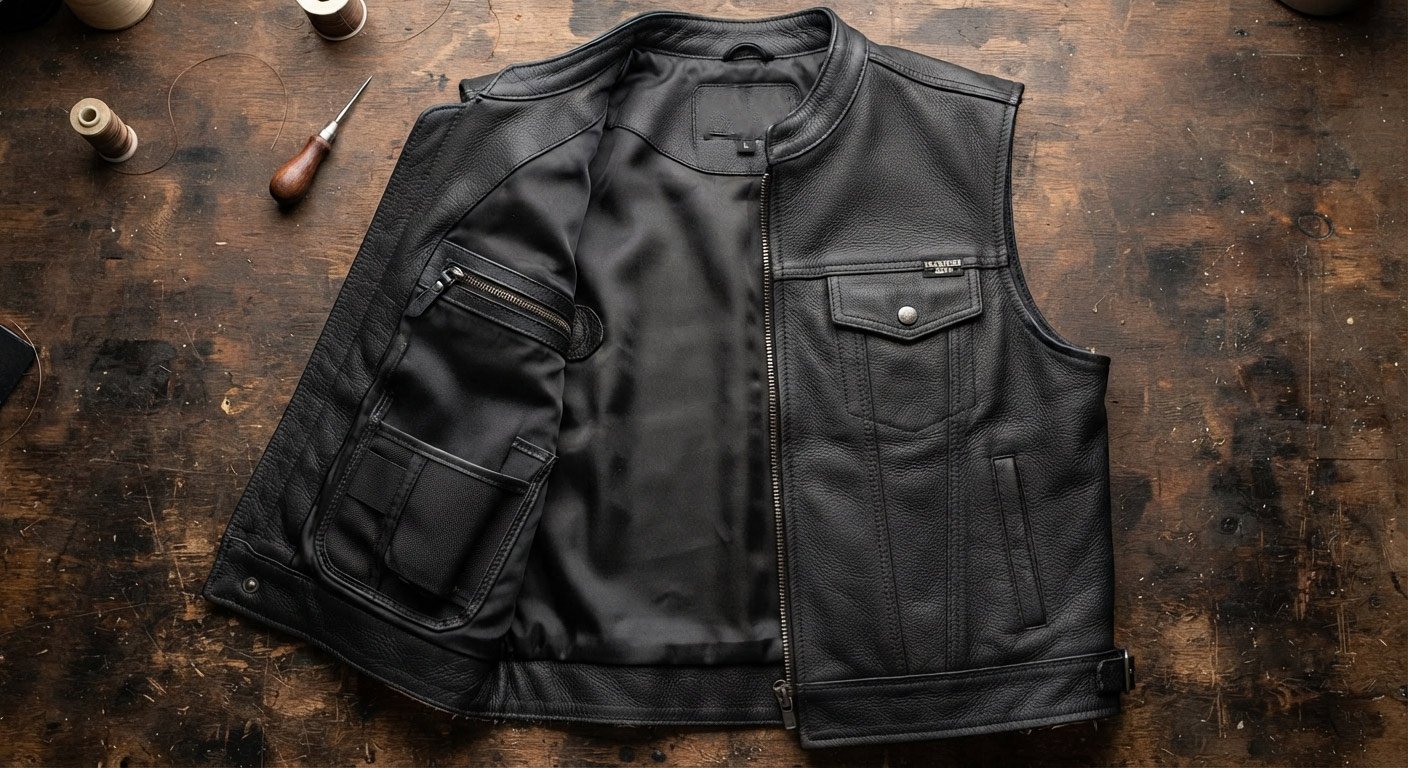
Types of Leather Vest Pockets: Which Configuration Fits Your Ride?
Pocket configuration should match how you actually carry, not how a vest looks on a rack. Riders who run saddlebags need only 2–4 pockets; everyday riders do well with 5–7; touring and utility riders benefit from 8 or more, including a hidden security pocket for valuables. Concealed carry riders need one specific thing above all else — correct pocket placement, not pocket count.
Why Pocket Count Isn’t the Right Starting Question
Most buyers don’t think about pocket configuration until they’re on the bike and realize their vest doesn’t match how they ride. The better starting question isn’t “how many pockets,” it’s “what do I actually carry, and how do I need to reach it while riding.”
- 2–4 pockets: enough if saddlebags or a tank bag carry the bulk of your gear
- 5–7 pockets: the sweet spot when the vest handles most day-to-day storage
- 8+ pockets: built for utility and adventure riders who use the vest as primary on-body storage
Interior vs. Exterior Pockets
Exterior pockets are the easiest to access — you can reach them without opening the vest. The tradeoff is visual: too many exterior pockets, flaps, and zippers can make a vest look cluttered, and on a club-style build they compete for space with front panel real estate.
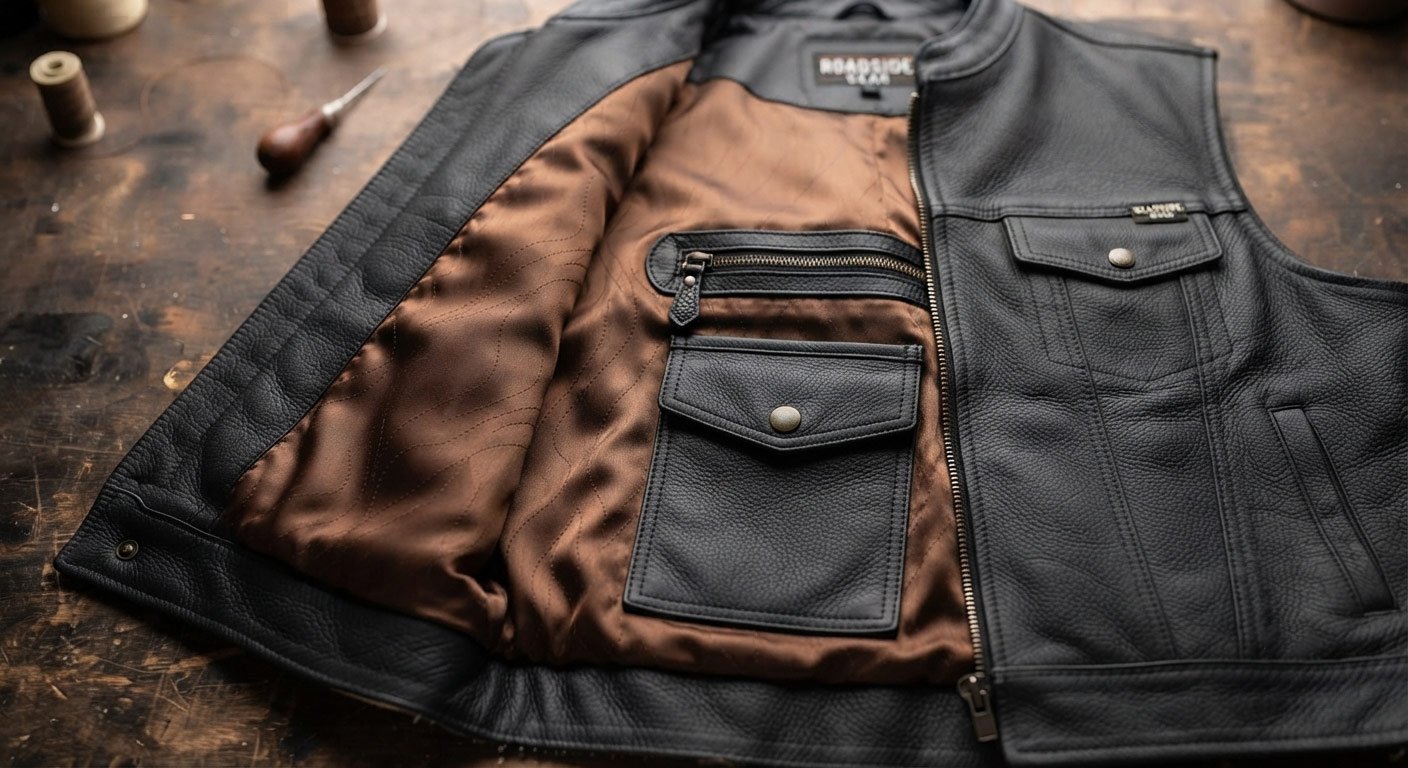
Interior pockets keep the outside clean and are more secure — nothing swings open at speed, and contents are less visible to anyone standing nearby. They’re the standard choice for phones, wallets, documents, and anything you’d rather not lose on the highway.
Most well-designed vests use a mix: one or two exterior chest pockets for quick-access items, with interior pockets handling everything else.
The Hidden Security Pocket
A pocket sewn into the back lining — invisible from outside and inaccessible without removing the vest — is a touring-rider staple for cash, a spare key, or a copy of documents you don’t want visible even if the vest is searched or left unattended for a moment.
Closure Types: Snap, Zipper, or Hook-and-Loop
- Snap closures — fastest, one-handed operation, the classic biker look
- Zippers — most secure against contents falling out, slightly slower to open
- Hook-and-loop (Velcro) — quiet and fast, but wears out and loses grip faster than metal hardware over years of use
For a pocket carrying something you genuinely can’t afford to lose — keys, cash, a firearm — a reinforced snap or a quality zipper is the more durable long-term choice over hook-and-loop.
Pocket Backing and Printing
Anything with real weight — a phone, a wallet with cards, or a holstered firearm — needs a reinforced panel behind the pocket. Without it, the pocket sags out of shape over time and the contents “print” visibly against the leather, which defeats the purpose of an interior pocket in the first place. Full-grain leather holds its shape under weight naturally better than thinner splits or synthetic backing.
Match Your Setup to How You Actually Ride
| Rider Type | Recommended Pocket Setup |
|---|---|
| Minimalist / runs saddlebags | 2–4 pockets — one interior utility pocket is often enough |
| Everyday / commuter rider | 5–7 pockets — interior utility pocket plus a couple of snap-close exterior chest pockets |
| Touring rider | Zippered chest pockets, deep hip pockets, and a hidden security pocket in the back lining for valuables |
| Concealed carry rider | Dedicated holster-compatible interior pocket, positioned high on the left front panel with reinforced backing |
| Club / patch rider | Minimal front pockets, kept clear of the back panel entirely so it stays open for patches |
| Utility / adventure rider | 8+ pockets — vest functions as primary on-body storage |
Concealed Carry Deserves Its Own Conversation
If you carry, pocket placement is a fit and safety issue as much as a storage one — position, orientation, and draw access matter more than pocket count.
See our full breakdown: Concealed Carry Leather Vest Guide: Pocket Placement That Actually Works
Club Riders: Keep the Back Clear
If a patch set is in your future, pockets belong on the front only. The back panel needs to stay a single, uninterrupted piece of leather for a three-piece patch layout. See our guide on back panel construction for how that panel is built.
Build Your Pocket Layout
Every LMCV vest ships with pocket configuration handled in-house — size, count, closure type, and CCW placement, all custom. Start with the Custom Leather Motorcycle Vest Guide, or browse Biker & Motorcycle Vests to see pocket-ready styles.
FAQ (for schema markup)
Q: How many pockets should a motorcycle vest have?
A: It depends on how you ride. Two to four pockets is enough if you run saddlebags; five to seven works when the vest handles most of your day-to-day storage; eight or more suits utility and adventure riders who treat the vest as primary on-body storage.
Q: Are interior or exterior pockets better on a leather vest?
A: Exterior pockets are faster to access without opening the vest; interior pockets are more secure and keep the front cleaner. Most well-designed vests use both — exterior for quick-access items, interior for valuables.
Q: What is a hidden security pocket on a motorcycle vest?
A: A pocket sewn into the back lining, invisible from the outside and only reachable by removing the vest — commonly used by touring riders for cash, a spare key, or backup documents.

About author

Related posts
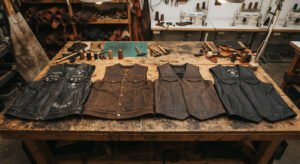
A good leather motorcycle vest comes down to five decisions: the right leather type for your riding style, an accurate chest-based size, a pocket layout... Continue reading
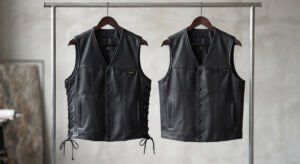
Side-lace vests use adjustable lacing at the ribcage for roughly 3–4 inches of torso adjustment — useful for riders who layer heavily by season or... Continue reading

A patch-ready back panel is a single, uninterrupted piece of leather with no vertical center seam, cut from leather in the 2–3oz range (about 0.8–1.2mm)... Continue reading
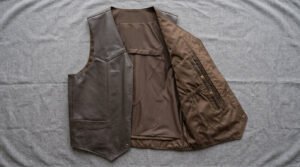
A true CCW-ready vest has one or more interior pockets sized and positioned to hold a holstered handgun at mid-chest level, opening toward the front... Continue reading

In summer, wear the vest alone over a lightweight or moisture-wicking shirt. In fall and spring, layer it over a flannel or thermal shirt. In... Continue reading
Add comment